
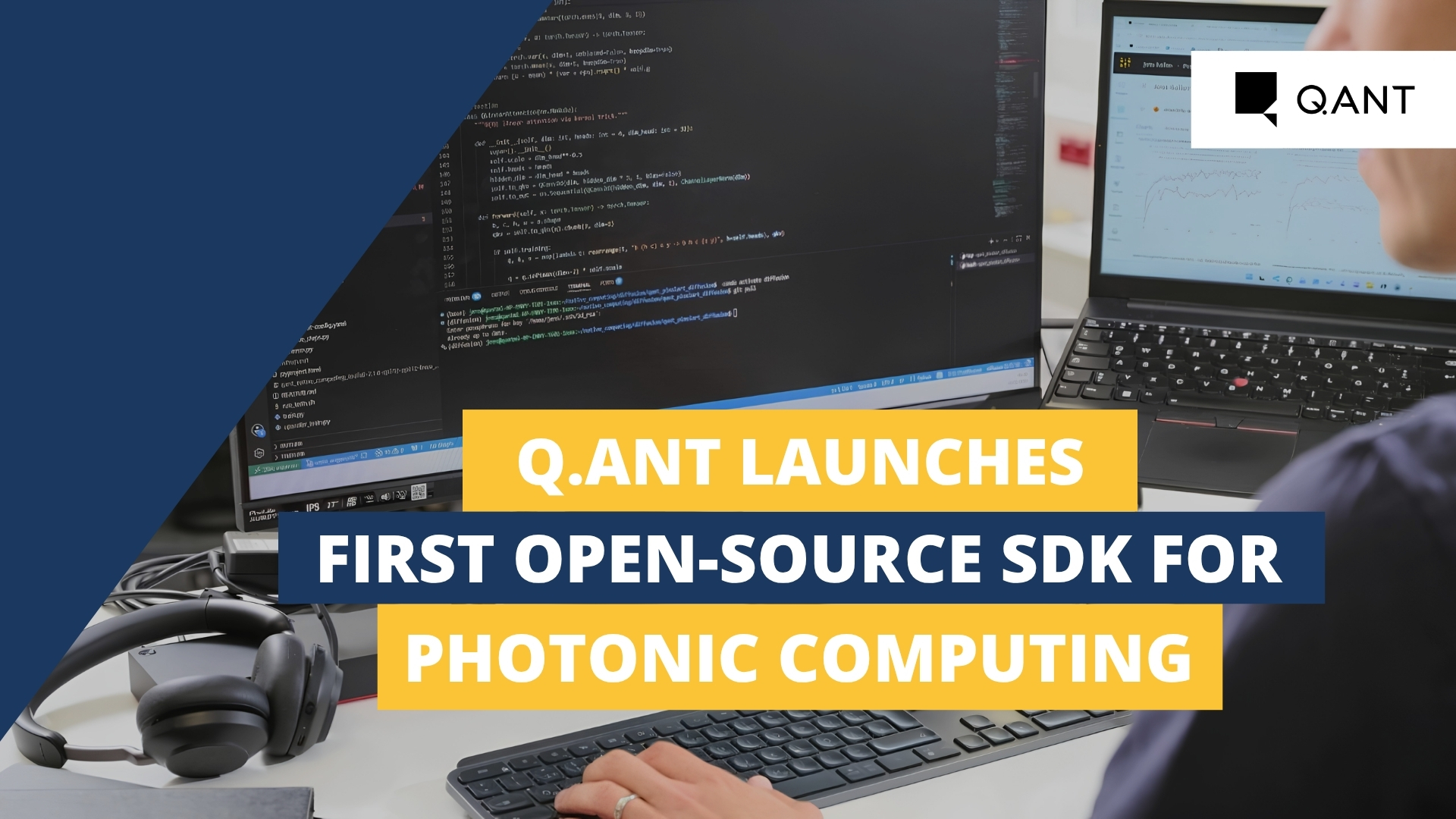
Our prestigious portfolio company Q.ANT, the Stuttgart-based pioneer in photonic computing, has launched the first open-source SDK for a photonic processor. For the first time, developers can write, run and test applications that compute with light instead of electricity. Moreover, all they need to get started is a laptop.
Why an Open-Source SDK Matters for Photonic Computing
AI is running into a physical wall. In classical computing, most energy goes into moving data back and forth between memory and processor. As models grow, so do cost, complexity and power demand.
Q.ANT tackles this problem at its root. Its photonic chip performs calculations in the optical domain, where non-linear functions run natively. As a result, networks can be more expressive with fewer parameters. Less data has to move, and energy efficiency improves further.
However, new hardware alone does not create a market. Developers need tools they already understand. That is exactly the gap the new SDK closes.
What the Q.ANT SDK Offers Developers
The SDK gives programmers everything they need to build for Q.ANT’s Native Processing Units (NPUs). It includes an API for C and Python, sample applications and full documentation. In addition, a simulation backend runs on any standard CPU. Developers can therefore build and validate applications on their own machines first, and then move them to real photonic hardware.
The examples draw on Q.ANT’s published reference applications. For instance, one compares a classical neural network with a network based on photonic native operations. It benchmarks parameter count, accuracy, functional approximation and training loss side by side.
“An ecosystem isn’t created by hardware alone. It emerges when the software layer is open and others can build on it,” said Michael Förtsch, Founder and CEO of Q.ANT. He calls the release “the ‘Linux moment’ of photonic computing: the point at which a new possibility becomes a global platform.”
The toolkit is available now on GitHub, as described in the official press release.
From Laboratory to Platform
This launch is a strategic step. Q.ANT is building the SDK together with HPC centers such as the LRZ and JSC, and with the neo-cloud provider IONOS. In the coming months, the company will also open hardware access through the IONOS cloud or through on-premise installations of its Native Processing Server. Developers who start today will be ready as soon as that access goes live.
Utz Bacher, VP of Software at Q.ANT, puts it simply: “If you want to get started, all you need is a laptop.” No knowledge of photonics and no special hardware is required.
Independent analysts see the potential too. Hyperion Research points to AI inference and training, scientific computing and image processing as key areas where Q.ANT’s processor can work alongside CPUs and GPUs.
The launch builds on a remarkable track record. Since the €62 million Series A, in which ESAC participated, Q.ANT has installed its second-generation processor at leading scientific computing centers. Meanwhile, it has opened a U.S. office in Austin, Texas.
Proud to Accompany Q.ANT on This Journey
We are proud to accompany Q.ANT as it turns photonic computing from a breakthrough technology into an open platform. By opening its software layer, the team invites developers worldwide to build on European deep tech.
Congratulations to Michael Förtsch and the entire Q.ANT team on this milestone. It shows how European innovation can shape the future of energy-efficient AI. Discover more of our portfolio companies and the founders we are proud to support.
Latest News
 Q.ANT Launches First Open-Source SDK for Photonic Computing23. September 2026 - 16:23
 sproof and A-Trust Deepen Their Sovereign Alliance for Austria19. June 2026 - 14:29

