
The future of computing is increasingly being shaped by new architectures that can overcome the physical and energy limitations of conventional processors. One of the most promising technologies leading this transformation is photonic computing — and Q.ANT is now receiving international recognition for its pioneering work in the field.
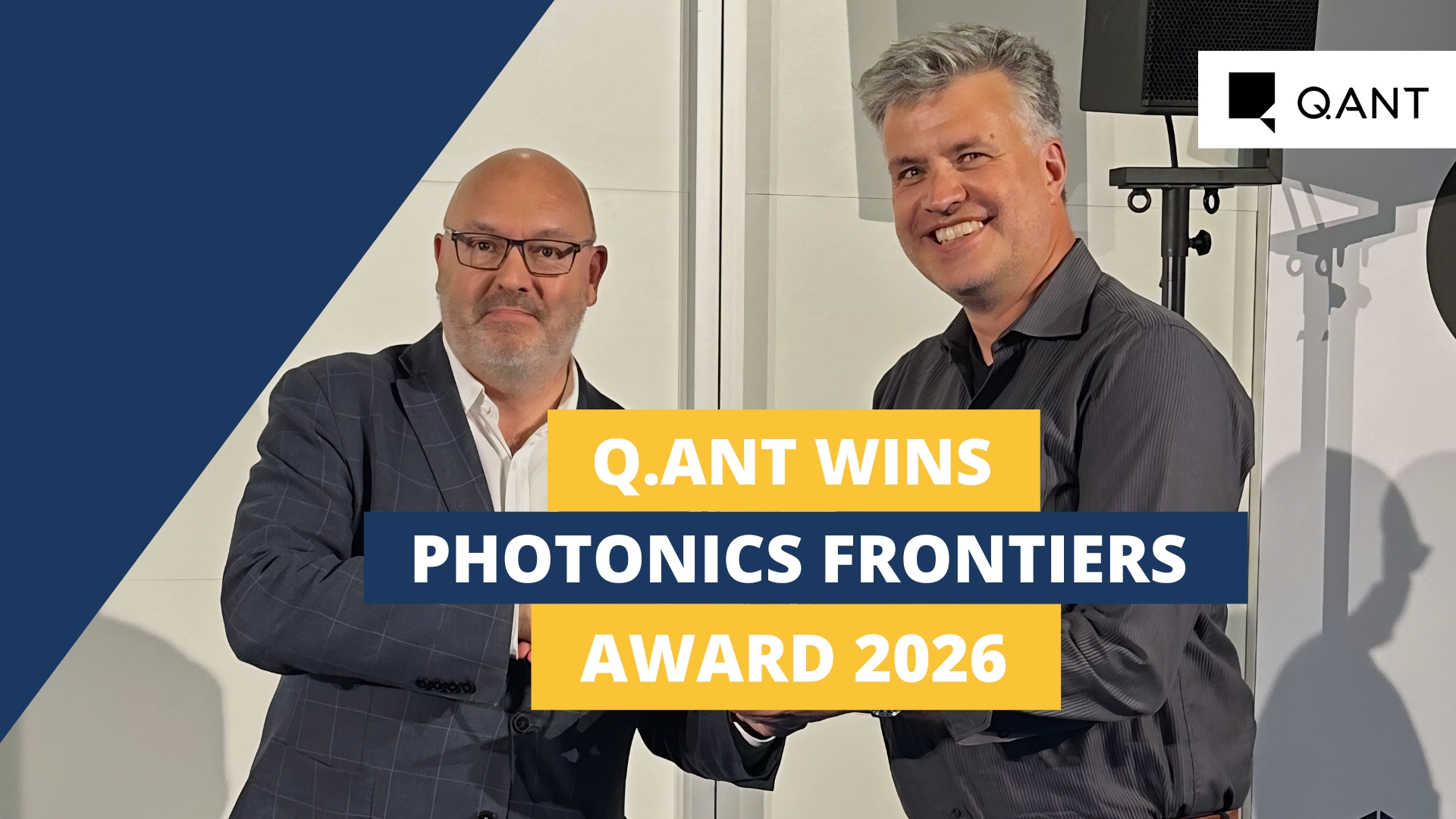
At Optatec Messe 2026 in Frankfurt, Q.ANT was awarded the prestigious Photonics Frontiers Award 2026 in the category “Quantum Technologies & Optical Computing” for its industry-ready photonic co-processor.
The award, organised by Electro Optics, recognizes technologies that demonstrate tangible market impact rather than purely theoretical potential. For the rapidly evolving fields of optical and quantum computing, this distinction carries particular significance: it signals that photonic computing is no longer confined to research laboratories, but is entering real-worldindustrial deployment.
A Milestone for Optical Computing
Q.ANT’s award-winning photonic co-processor represents a major step toward next-generation computing infrastructure. Unlike traditional semiconductor-based processors, photonic computing uses light instead of electricity to perform calculations. This fundamentally different approach enables significantly higher energy efficiency while simultaneously increasingcomputational performance.
As artificial intelligence systems continue to scale and demand exponentially more processing power, conventional chip architectures are increasingly approaching physical and thermal limits. Photonics offers an alternative path forward — one capable of supporting the growing computational requirements of AI and high-performance computing applications.
The recognition at Optatec highlights the broader momentum behind photonic technologies as the industry searches for more scalable and sustainable computing solutions.
Recognition Among Leading Global Innovators
The competition for the award featured an impressive group of international finalists, including Lightmatter, Quside, AUDI AG, SCINTIL Photonics and Voyant Photonics.
The award was presented by Mark Elliott, who praised Q.ANT’s achievement in his laudatio:
“We’ve been talking about optical AI processors for a decade. They’re doing it. They’re delivering them. It’s hard to think of a more impactful and timely bit of innovation.”
The jury specifically highlighted Q.ANT’s ability to move beyond conceptual discussions and bring an industry-ready photonic co-processor to market — a milestone many in the sector have long anticipated.
For Q.ANT, the award was accepted by Michael Krueger, VP Commercials, during the ceremony at Optatec Messe in Frankfurt.
Why Photonic Computing Matters
The rise of AI has created unprecedented demand for computational resources. Data centers and AI infrastructure are facing mounting pressure from energy consumption, cooling requirements, and hardware scalability challenges.
Photonic computing addresses these bottlenecks at the architectural level. By computing natively with light, photonic systems can dramatically reduce energy consumption while maintaining high-speed data processing capabilities. This has the potential to reshape industries ranging from artificial intelligence and cloud computing to industrial automation and advancedsimulations.
Importantly, this development is not merely an incremental improvement over existing systems. It represents the emergence of an entirely new computing paradigm.
A Strong Signal for Europe’s Deep Tech Ecosystem
For Europe’s innovation ecosystem, Q.ANT’s recognition demonstrates the growing global competitiveness of European deep tech companies in highly strategic technology sectors.
The European Super Angels Club is proud to see Q.ANT receive international recognition for its groundbreaking work in photonic computing. The Photonics Frontiers Award 2026 highlights not only Q.ANT’s technological leadership, but also the growing relevance of European innovation in shaping the future of AI infrastructure and next-generation computing architectures.
Latest News
 Biome Diagnostics Starts Helsana Partnership in Switzerland9. October 2026 - 12:40
 sproof Launches the EUDI Pioneers Consortium7. October 2026 - 13:14
 FraudFinder Joins the Provenir Marketplace5. October 2026 - 12:41

